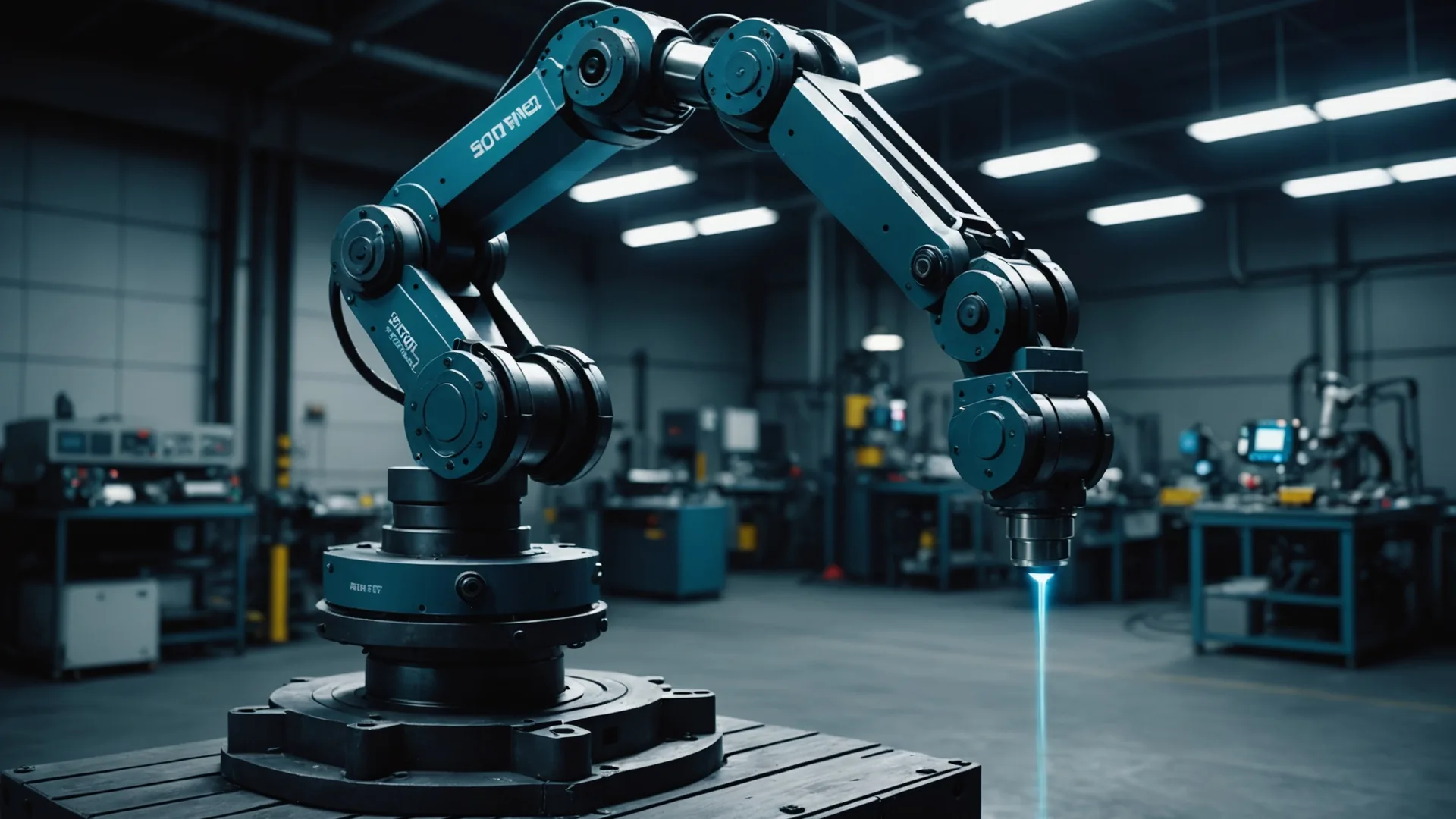
Factory robots that generalize. Train once, adapt to any part.
RLWRLD's manipulation foundation model reads object geometry at pickup time, so a robot cell handles a new SKU without an engineer re-teaching every grasp.
Re-teaching a robot cell costs weeks and thousands of dollars
Every new part variant forces a robotics engineer to hand-program new grasp poses, update vision pipelines, and run hundreds of test cycles. That friction caps how fast manufacturers can iterate.
Traditional robot programming requires offline teach-in for every geometry variant. A mix of 50 part variants can mean months of integration work per cell.
Grasp programs tuned for one part orientation break when parts arrive at a different angle or with cosmetic variation. Catch rate drops and rejects pile up.
Re-teaching requires specialized knowledge that most manufacturers have to outsource. Lead times stretch to months; every iteration adds cost.
A foundation model that reads geometry, not programs
RLWRLD captures point-cloud and force-torque data at pickup time, runs it through a transformer backbone pre-trained on 3.2 million manipulation demos, and outputs grasp parameters in real time.
Designed for industrial-grade manipulation
The model infers grasp candidates directly from point-cloud geometry. No CAD file required. No prior training on that specific part.
Runs on embedded GPU at the cell edge. Latency under 80ms end-to-end from sensor input to joint command, compatible with standard PLC cycle times.
Closes the manipulation loop with real-time force-torque sensing. Detects slip and replan mid-grasp, recovering failed picks without operator intervention.
REST and SDK interfaces for FANUC, KUKA, and ABB arms. Drop-in middleware layer; your existing PLC and MES integrations keep working.
Every production pick is a training signal. The model fine-tunes on cell-specific data, improving catch rates over weeks of operation without engineer input.
Inference runs fully on-site. No part geometry, sensor data, or proprietary process information leaves the factory floor. ISO 27001 aligned deployment procedures.
Running in precision manufacturing cells today
Selected pilot partners are deploying RLWRLD across high-mix, low-volume assembly lines where frequent SKU changes make traditional programming economically unviable.
Introduced 12 new part profiles over 6 weeks without reprogramming the pick cell. Zero offline teach-in sessions during that period.
SKU changeover time on a packing line trial reduced from 3 days to under 4 hours. Zero-shot grasp performance on cast aluminum parts from a supplier they had never processed before.
94% pick success on metal stampings of varying thickness at first deployment, with no prior part-specific training. The model read their depth sensor data and generalized from geometry alone.
Founded on peer-reviewed robotics science
Our team publishes at top robotics venues. The manipulation model is built on documented methods, not black-box engineering.
We introduce a point-cloud transformer architecture pre-trained on 3.2M manipulation demonstrations that achieves 94% zero-shot grasp success on never-seen industrial parts.
We show that closing the manipulation loop with force-torque feedback reduces mid-grasp slip by 61% compared to vision-only baselines on metallic parts under industrial lighting variation.
Ready to eliminate re-teaching from your production line?
We are onboarding a limited number of manufacturing partners for the 2026 early access program. Applications are reviewed by our engineering team.