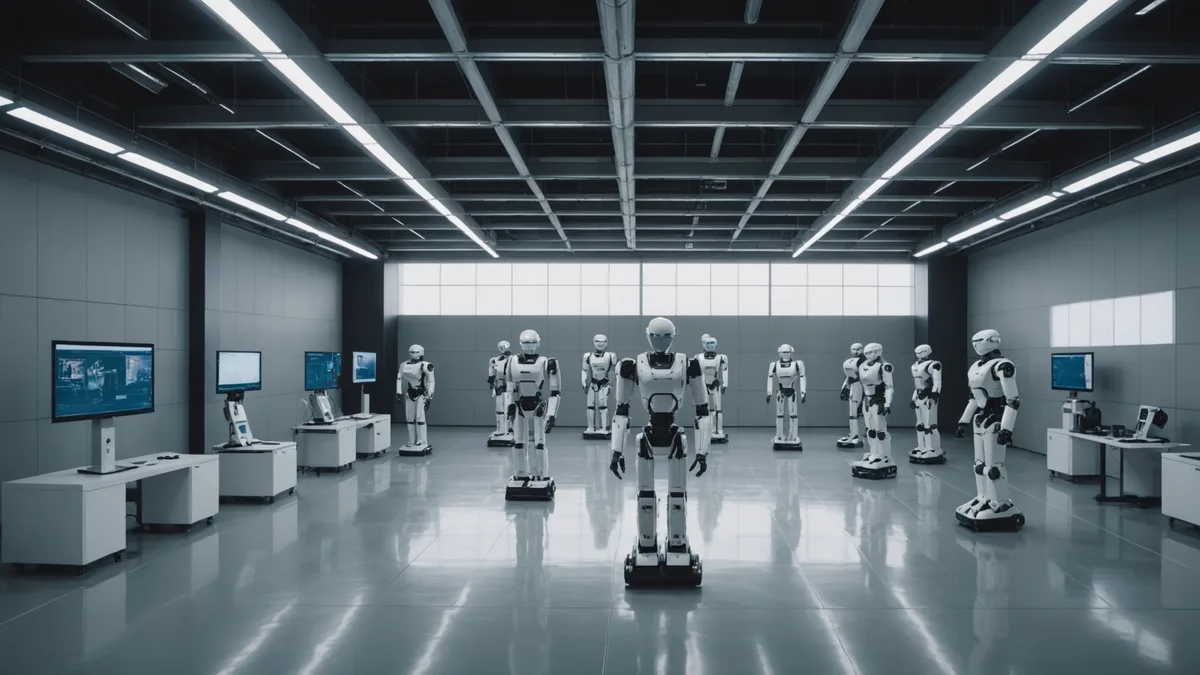
RLWRLD is now an associate member of the Japan Robot Association (JARA, Nihon Robot Kogyo-kai). We applied for associate membership in September 2025 and completed the process in November. This post explains why we pursued this, what we expect to get from it, and what it means for the technical direction of what we are building.
Why JARA Specifically
Japan is the world's largest robot manufacturing country by value. The domestic robot industry here has a different character than what you see in the European or US robotics communities. It is older, more conservative, and much more deeply embedded in the manufacturing supply chain. The companies that matter in Japanese manufacturing automation are typically not early adopters of external software platforms. They build and maintain their own toolchains, they work through established channels, and they make long-term commitments carefully.
JARA is the primary trade and standards organization for that community. It covers robot manufacturers, integrators, component suppliers, research institutions, and increasingly, software companies operating in the industrial robotics space. Associate membership gives smaller organizations like ours structured access to the working groups and technical committees where industrial robotics standards are shaped, as well as to the exhibitions and technical events that bring the manufacturing community together.
The practical implication for us is access. We are a small team building software that has to run reliably in real factory cells built around hardware from established Japanese and international robot manufacturers. Understanding the hardware and integration constraints from the inside, through direct contact with the people who build and deploy this equipment, is something we cannot replicate by reading specifications alone.
Standards Participation: What It Actually Means for Our Work
JARA participates in the development of JIS (Japanese Industrial Standards) related to robot safety, programming interfaces, and integration protocols. Some of this work feeds into ISO TC299, the international standards committee for robotics. For a company building a model that needs to run across multiple robot hardware platforms, the trajectory of interface and safety standards is not abstract. It determines which system integration patterns will be viable and which will require workarounds in two or three years.
Specifically, we are interested in developments around robot controller open interfaces, which determine how third-party software can interact with robot motion planning and control loops. The current generation of FANUC, Kawasaki, and Yaskawa controllers expose varying levels of programmability through their fieldbuses and external control interfaces. Understanding where the standards discussions are heading helps us make better architectural decisions about where our model sits in the stack: how much of the motion planning we own, what we delegate to the controller, and how we handle the latency and reliability constraints at that boundary.
We are not under the illusion that our participation as a small associate member will shape these standards in our direction. That is not the point. The point is that being in the room, or at least having access to the working group outputs before they become finalized text, gives us better signal on our own technical roadmap than we would have otherwise.
Testing Facilities and the Problem of Hardware Access
One of the concrete benefits that drove our application is access to JARA's testing and demonstration facilities network. For a small team without our own factory floor, getting hands-on time with industrial robot hardware requires either paying an integrator for access, negotiating access through a university lab, or relying on hardware we can afford to buy ourselves. None of these paths is as efficient as structured access to facilities designed for exactly the kind of evaluation work we need to do.
Physical testing on real robot hardware matters for what we build in a specific way. Our model's grasp policy outputs are validated in simulation and in our own lab setup, but the failure modes that show up when running on real factory hardware under realistic conditions are not fully predictable from simulation. The calibration drift of real depth cameras, the compliance characteristics of real cable management, the vibration coupling between conveyor and sensor mount: these variables appear in simulation as idealized parameters but show up in real hardware as correlated sources of noise that affect the model's perception inputs. Having more structured access to hardware for evaluation is directly valuable.
The Manufacturing Partner Community
JARA membership is also an introduction channel into the broader Japanese manufacturing ecosystem. We are not expecting introductions to turn directly into commercial relationships in the short term. What we are expecting is more and better conversations with the automation engineers, cell designers, and production engineers who will eventually be the people evaluating whether our technology fits into their cells. Understanding their operational constraints, their decision timelines, and the specific part families they care about is input we need to build the right thing.
The conversations we have had through the JARA network so far have already shaped our thinking on re-teaching costs, which we wrote about separately. That kind of ground-level operational insight is what we are building toward as a product development input, not just as a sales motion.
What This Does Not Change
Being an associate member of an industry association does not mean we have a commercial footprint in Japanese manufacturing. We do not. We are an early-stage company with a foundation model in development and a small set of evaluation partnerships. JARA membership is an input to our research and engineering process, not a commercial milestone.
It also does not mean we are Japan-only. We are based in Tokyo because that is where our founding team is, and because Japan's manufacturing density is a practical advantage for the kind of ground-level hardware learning we described above. But the problem we are solving, robot cells that cannot handle new part geometries without re-teaching, is not Japan-specific. The technical approach generalizes. The deployment community we are building toward includes manufacturing environments in Korea, Taiwan, and Germany as well.
For now, the JARA membership represents one piece of how a small team in Bunkyo-ku tries to stay connected to the manufacturing world it is building for. We expect to write more about what we learn from that connection as we go.