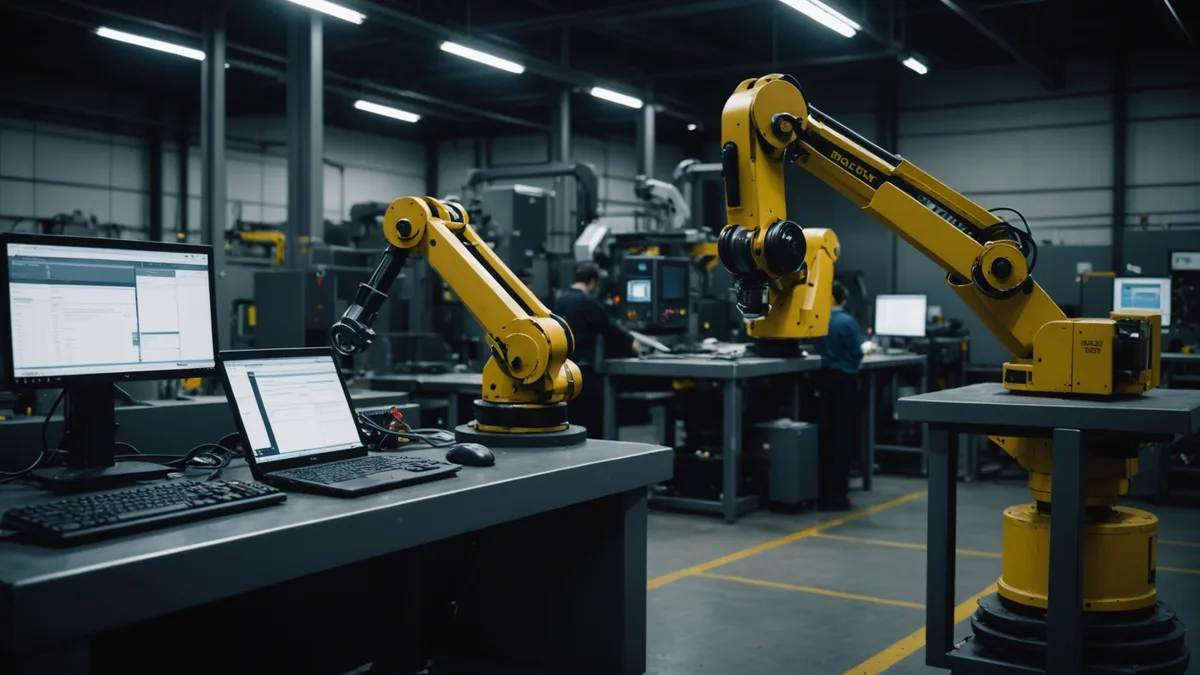
When you ask automation engineers how long it takes to re-teach a robot cell for a new SKU, they typically give you a number in hours. Four hours for a minor geometry change. A full day if the new part requires a different grasp strategy. These numbers are real, but they are not the full cost. The rest of the cost is distributed across budget lines and operational reports in ways that make it almost impossible to see from a single dashboard.
Over the past year we have been talking with automation engineers at manufacturing facilities in Japan and Southeast Asia, ranging from electronics assembly job shops to mid-volume automotive suppliers. We were trying to understand what flexible robot deployment actually looks like in practice, not in brochure language but in the operational detail. What we kept hearing was a version of the same story: re-teaching is painful in ways that the factory's own metrics are not set up to capture.
What a Re-Teach Cycle Actually Involves
The teach pendant view of re-teaching, in which an engineer guides the robot arm to a few target positions and saves them, is accurate for simple positional tasks. For a pick cell handling varied part geometries, the full cycle is considerably more involved.
A complete re-teach for a new part geometry typically requires: retrieving or creating a 3D model or dimensional drawing for reference, running a calibration sequence to verify the cell's spatial reference frame against the fixture, generating a candidate set of grasp points either analytically or through simulation, manually guiding the robot to each candidate and evaluating stability, iterating on approach angle and contact position until the grasp success rate at production speed meets the acceptance threshold, updating the robot controller program, and documenting the changes in the cell's configuration record. That last step is frequently skipped under time pressure, which creates a separate category of future cost.
If the cell uses a depth camera for part detection, the re-teach also includes updating or retraining the detection pipeline for the new part's appearance in the sensor's field of view. This is the step that most often requires calling an external integrator rather than being handled in-house, because the vision configuration typically involves software tools the integrator supplied and the factory's own team has limited access to.
Where the Costs Actually Live
The direct cost of lost production during the re-teach is visible in the planned downtime metric. A cell producing at moderate throughput and running two shifts will accumulate meaningful lost-unit count during even a half-day offline window. But this appears in the production report as scheduled maintenance, not as a flexibility cost, and it is treated accordingly: it gets planned around, not eliminated.
Integrator fees are the second cost that engineers mention consistently. Many factories do not maintain in-house staff with the depth of robot programming knowledge needed to handle all re-teaching reliably, especially for cells with vision systems or force-torque sensing. Calling the system integrator for a re-teach day is treated as a maintenance expense rather than a production cost, which means it does not flow into the per-part cost calculation for the new SKU. It sits in the maintenance budget and gets treated as a fixed operational overhead.
Scheduling lag is the third cost and the hardest to quantify. Because re-teaching requires planned downtime, it gets batched into maintenance windows that may be days or weeks away from when the new SKU decision was made. During that interval, production of the new part is either deferred or handled by a slower manual process. The connection between "we need this robot to handle the new connector" and "the order shipped late" is typically not traced in the ERP system.
The fourth cost is quality recovery in the first production runs after a re-teach. Grasp positions dialed in manually at reduced speed do not always hold at full production speed, especially for parts with fine tolerances or variable surface finish. The defect and drop rate in the first hour of production after a re-teach is systematically higher than steady-state. This gets absorbed into the normal quality variance and is rarely attributed to the re-teach event.
Why Standard Metrics Obscure the Problem
OEE, the primary productivity metric in most manufacturing environments, has a specific relationship with re-teaching that makes the cost structurally invisible. OEE separates planned downtime from unplanned downtime, and planned downtime is excluded from the availability calculation. A re-teach is planned downtime. The OEE number does not reflect the flexibility tax at all.
This is not a flaw in OEE as a metric. OEE measures how efficiently a cell is running when it is supposed to be running. The problem is that it is often the only metric used to evaluate cell performance, which means the question "how much does it cost us to introduce new parts into this cell?" has no standard answer in most factories' reporting structure.
When engineers try to build the business case for more flexible automation, they have to construct the cost estimate manually. They pull downtime records, integrator invoices, and production variance reports and stitch them together. The engineers who do this work consistently arrive at numbers that surprise management, because the costs are real but the reporting structure does not surface them automatically.
The High-Mix Compounding Problem
For factories running 20 or more active part numbers through a robot cell, re-teaching overhead compounds across the year. Consider a cell that handles 25 SKUs and rotates through a mix where any given SKU might be in production for a few weeks before being swapped out or revised. If each rotation requires any portion of a re-teach cycle, the cumulative downtime and integrator cost across a year can represent a substantial fraction of the cell's total operating cost.
The problem is not symmetric. A factory running a single high-volume SKU on a dedicated cell has no re-teaching overhead at all. The cost is concentrated in high-mix, lower-volume production, which is precisely the segment of manufacturing that is growing: contract electronics assembly, automotive tier-2 suppliers handling custom variants, and medical device subassembly. These are also the factories where the margin per part is thinner, which makes the hidden flexibility tax proportionally more damaging.
A Nuanced View: When Re-Teaching Is Appropriate
We are not arguing that re-teaching is always avoidable or that it represents pure waste. Precision assembly tasks with sub-millimeter tolerances, parts that require specific gripper tooling, and applications where force-torque profiles must be tuned to particular material properties may genuinely require human engineering input for each new part. There is a category of manufacturing work where careful, deliberate robot programming is the right answer and the cost is justified.
The problem we are focused on is different: the cases where re-teaching is required not because the task demands it, but because the robot's perception and grasping policy cannot generalize across the geometry variation in the new SKU. A cell that re-teaches when the outer diameter of a bearing changes by a few millimeters is not failing because the task is hard. It is failing because the policy has no mechanism for transferring what it knows about cylindrical part grasping to a slightly different cylinder.
That is the specific failure mode RLWRLD is building toward eliminating. The goal is not a robot that never needs programming. It is a robot that distinguishes between changes that require re-teaching and changes that fall within its learned generalization space, and handles the latter automatically. The cost accounting for that distinction turns out to be more significant than we expected when we started these conversations.